
Infectious Diseases Between Fear and Awareness: Protecting the Family Without Exaggeration | A Preventive Guide
Summary: A practical guide to dealing with infectious diseases with awareness and without panic: modes of transmission, home prevention steps, when to see a doctor, and the role of vaccinations in protecting the family.
Moments of joy in our homes pass quickly, while the days and hours when a family member is sick feel painfully slow; whether it is a young child with a high fever, an elderly person with a persistent cough, or a teenager suffering from headaches for days. In those moments, everyone experiences an unspoken state of anxiety—not fear of the symptom or illness itself, but fear of the unknown: Is it contagious? Is it serious? What should we do? And is the information we received even correct? Do the same medications that worked before apply to these similar symptoms?
Statistics confirm that awareness—not fear—is the most important factor in reducing the spread of infectious diseases, contrary to what many used to believe. The COVID-19 pandemic strongly proved this idea; many who relied only on fear as a protective shield became infected along with their families, while those who acted with awareness and health literacy were better able to protect themselves and their households.
The World Health Organization estimates that simple preventive practices such as proper and regular handwashing can reduce acute respiratory infections by up to 17%, and diarrheal diseases by up to 30%.
In Saudi Arabia, national health awareness campaigns during the COVID-19 pandemic showed that health education significantly changed people’s behavior: about 7 out of 10 citizens reported changing their health habits after following official educational content from the Ministry of Health.
All of these numbers lead us to one conclusion: Fear does not prevent infection… awareness does.
1 – What Are the Most Common Infectious Diseases in Saudi Arabia?
Not all infectious diseases are “deadly” or “rare.” Many are encountered daily at home, especially with seasonal changes and frequent mixing in schools, workplaces, and gatherings. Among the most common are respiratory infections such as colds, influenza, and throat infections, in addition to gastrointestinal infections sometimes linked to contaminated food or water, which may increase during travel and events.
On the level of surveillance and awareness, health authorities monitor specific diseases within prevention programs, such as dengue fever, vector-borne diseases, viral hepatitis, chickenpox, and meningitis, while issuing guidelines to reduce transmission.
Awareness becomes even more critical during Hajj and Umrah seasons; the number of pilgrims in Hajj 1445H reached 1,833,164, including 1,611,310 from outside the Kingdom. This increases the likelihood of disease transmission if preventive measures are not strictly followed, especially in large gatherings where risks of diseases such as meningococcal infections may rise. Similarly, major events like Riyadh Season—which reportedly attracted 13 million visitors in 2024—make adherence to ventilation, cough etiquette, hand hygiene, and staying home when symptomatic essential practices to reduce transmission.
Conclusion: Crowding and diversity do not mean infection will inevitably spread, but they do increase the likelihood—and awareness is the first line of defense for protecting families and society.
2 – How Do Infectious Diseases Spread Within the Family?
Infection does not always come from outside. Sometimes it spreads in the simplest daily moments without us noticing.
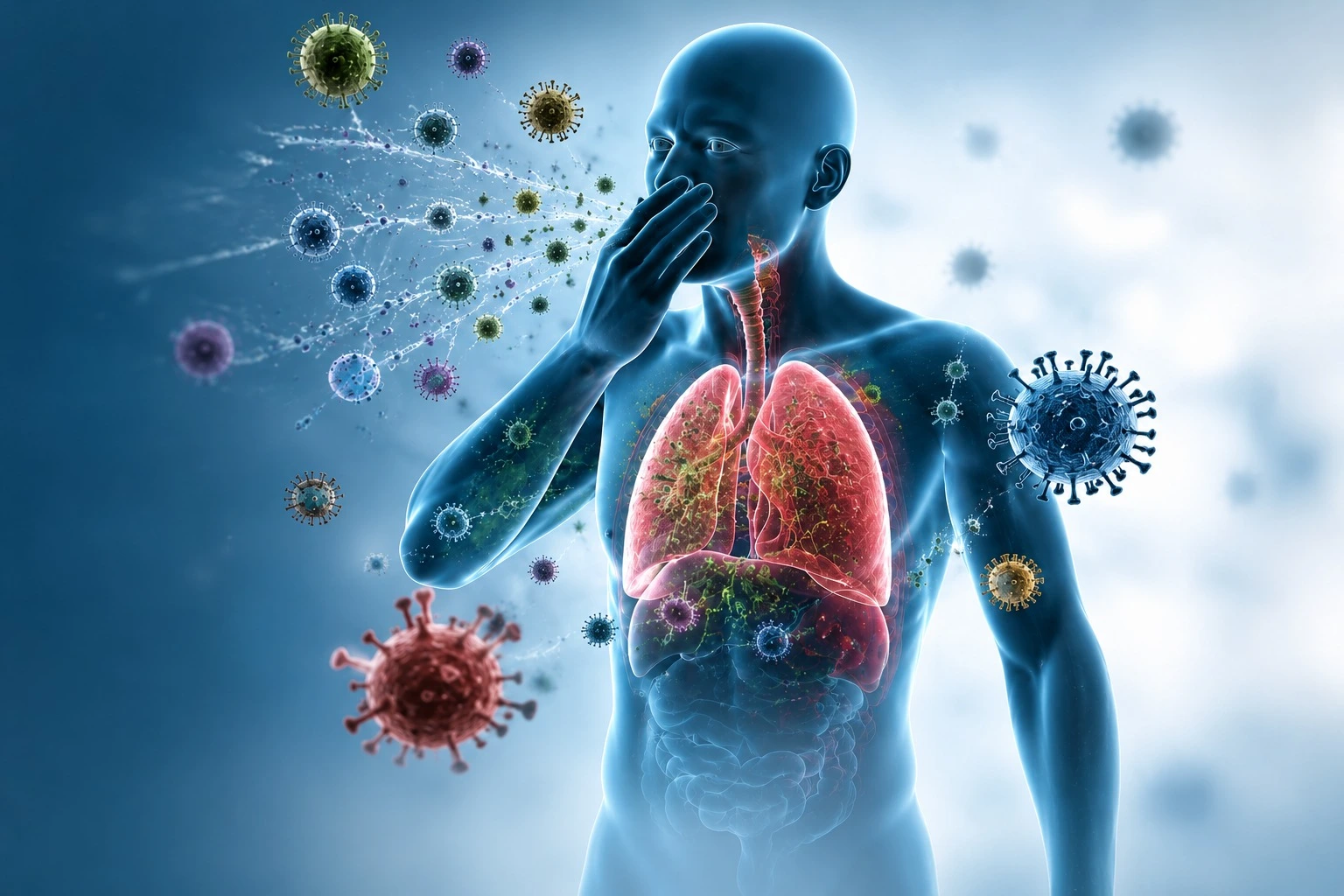
- Respiratory droplets: The fastest route for virus transmission, especially in closed, poorly ventilated spaces. Sneezing, coughing, and close talking can transmit infection among family members.
- Contaminated surfaces and hands: Phones, doorknobs, tables, and shared kitchen tools can retain viruses and bacteria for hours.
- Contaminated food and water: Poor washing of vegetables, improper food storage, or using contaminated cooking tools are common causes of gastrointestinal infections.
- Insects and vectors: Such as mosquitoes and flies, which play a role in certain diseases in some regions of the Kingdom, which is why prevention campaigns include vector control programs.
Understanding transmission routes is the first step in prevention. Awareness here is a “shield,” not a burden.
3 – How to Protect Your Family Without Panic
- Regular handwashing at key times: before eating, after using the bathroom, and after returning home or touching shared surfaces.
- Daily home ventilation by allowing fresh air and sunlight to reduce microbial concentration.
- Following cough and sneeze etiquette using tissues or the elbow and disposing of tissues properly.
- Avoiding sharing personal items such as cups, towels, and toothbrushes during illness.
- Using medications responsibly and avoiding antibiotics without medical prescription to prevent antibiotic resistance.
Prevention is not the responsibility of one entity; it begins with simple daily habits practiced inside every home.
4 – When Should You See a Doctor? And When Is It an Emergency?
The Ministry of Health in Saudi Arabia provides the 937 service 24/7 and the “Sehhaty” digital platform for consultations and appointments, offering safe and fast channels that save time and reduce unnecessary crowding in healthcare facilities. However, there are cases that require immediate medical attention:
- Shortness of breath, severe chest pain, confusion/dizziness, severe dehydration, or persistent fever that does not improve.
- If symptoms do not improve within 48–72 hours, especially for children and the elderly, visit primary care.
- Unusual skin rash, repeated vomiting, or severe abdominal pain with fever.
- When a notifiable infectious disease is suspected, go to the nearest health center to prevent transmission.
5 – What Is the Role of Vaccinations and How Do We Respond to Common Myths?
Vaccinations are the strongest form of collective health defense, not an optional choice but a necessity to protect society. A common misconception is that “vaccines cause disease,” while in reality vaccines train the immune system safely to fight viruses without causing the illness itself.
Another misconception is that vaccines have not been tested long enough. This is incorrect; vaccines undergo rigorous laboratory testing and clinical trials before approval, followed by multiple medical reviews and regulatory approvals before public use. Therefore, correcting these misconceptions should rely on trusted official information rather than emotional debates, because prevention is a matter of science and knowledge, not personal opinions or experiences.
Key evidence-based facts include:
- Vaccinations can reduce mortality and infection rates for certain diseases by up to 90% in specific cases such as measles and polio.
- National immunization programs in Saudi Arabia consistently achieve coverage rates exceeding 95% in most regions, which is a major public health achievement.
- A common mistake is believing that “all infections require antibiotics,” while many infections are viral and do not respond to antibiotics.
Awareness is a Shield… Not Panic or Worst-Case Assumptions
Fear does not prevent disease, but it can increase anxiety and emotional burden. Awareness, however, creates a balance between caution and reassurance, enabling us to deal with infectious diseases confidently and responsibly.
Protecting our families does not mean isolation or obsession, but adopting simple conscious behaviors and spreading accurate information within our communities.
When every individual becomes a “health ambassador” at home, every household in the Kingdom becomes a strong barrier against infection and a pillar in achieving a major national goal: a healthy, aware, and sustainable society.
Sources & References
- Saudi Ministry of Health: Health Awareness Center (educational content on infectious diseases and prevention).
- Saudi Ministry of Health: Infectious disease control programs and surveillance systems.
- Saudi Ministry of Health: Hajj and Umrah vaccination requirements (2025).
- World Health Organization (WHO): Community infection prevention guidelines (2023).
- World Health Organization (WHO): Antimicrobial resistance report (2022).
- World Health Organization (WHO): Health awareness as a tool to reduce infection rates (2021).
- WHO: Health messages and guidelines for Hajj and Umrah, meningococcal disease alerts (2025).
- WHO Eastern Mediterranean Region (EMRO): Infection risks in mass gatherings (2023).
- General Authority for Statistics (GASTAT): Hajj statistics 1445H (2024).
- Scientific study: “Impact of health awareness messages on preventive behaviors during COVID-19 in Saudi Arabia”, Saudi Journal of Public Health (2022).
- Riyadh Season / official sources: 13 million visitors announcement (2024).


